Every great scientist starts with a question.
Why is the sky blue?
How do plants eat?
What’s inside a black hole?
Why does my dog tilt his head like that?
If you’ve ever wondered about the world — even for a second — congratulations.
You’ve already taken your first step toward becoming a scientist.
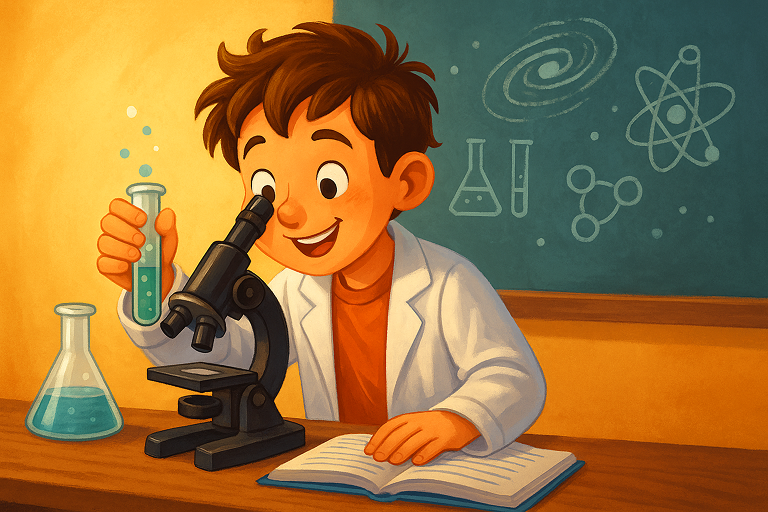
A scientist isn’t someone in a white lab coat holding test tubes all day.
A scientist is someone who never stops asking questions… and tries to find the answers.
Let’s explore how you can become one too — step by step!
🌟 Step 1: Start With Curiosity (Yes, That’s Enough!)
Every scientist was once a kid who:
- asked too many questions
- took apart toys
- mixed things “just to see what happens”
- looked at the sky and wondered
If you like exploring, observing, or imagining — you’re already on the right path.
🧪 Step 2: Learn the Basics in School
Subjects that help future scientists:
- Science (of course!)
- Math
- Environmental Studies
- Computer Science
- Geography
But don’t worry — you don’t need to be perfect.
Scientists make mistakes all the time.
What matters is staying curious and trying again.
🔬 Step 3: Experiment Like a Mini-Scientist
You can start right at home:
- Grow a plant and track its height
- Mix baking soda + lemon juice
- Make a DIY volcano
- Observe ants in your garden
- Look at the night sky through an app
- Try safe kitchen experiments with parents
A scientist learns by doing.
Even tiny experiments count.
📚 Step 4: Read, Watch, Explore
Science isn’t just in textbooks. You can learn from:
- documentaries
- kid-friendly science shows
- books about space, animals, oceans
- YouTube science channels (kid-safe ones!)
The more you learn, the more you start connecting the dots.
🎓 Step 5: Choose Your Science Path After Class 10
After 10th grade, kids who want to be scientists usually choose the Science stream.
You can pick:
- Physics + Chemistry + Math (PCM)
- Physics + Chemistry + Biology (PCB)
- Or all three if you love challenge!
This depends on what type of scientist you want to become.
🧠 Step 6: Pick Your Field (The Fun Part!)
Science has hundreds of careers. Here are some exciting ones:
🪐 Space Scientist
Studies planets, stars, galaxies (ISRO/NASA work)
🧬 Biologist
Studies plants, animals, humans
🔥 Chemist
Creates medicines, materials, perfumes, fuels
🦖 Paleontologist
Searches for dinosaur fossils
🌋 Geologist
Studies volcanoes, rocks, earthquakes
🤖 Robotics Scientist
Builds robots and cool machines
🧠 Neuroscientist
Studies how the brain works
🌱 Environmental Scientist
Protects the planet
There is a science career for every curiosity.
🎓 Step 7: College + Research = Scientist!
After high school, you study science in college:
B.Sc., B.Tech, or specialized degrees.
Then you can go deeper:
- M.Sc.
- PhD
- Research programs
- Science labs
- Work in universities, companies, or space/medical centers
This is where your ideas turn into discoveries.
🔭 Step 8: Discover Something New
Scientists:
- create new medicines
- build rockets
- study the climate
- invent new technologies
- protect wildlife
- explore oceans
- solve mysteries of life
Your job is to explore the unknown — how cool is that?
💡 Bonus: What Makes a Great Scientist?
Not perfect marks.
Not fancy equipment.
But:
- Curiosity
- Patience
- Creativity
- Hard work
- Asking questions
- Not giving up
Even failed experiments teach you something.
✨ A Final Thought
You don’t become a scientist in one day.
You become one every time you say:
“I wonder why…”
“What happens if…”
“Let me try again…”
Science begins in your mind — long before you ever enter a lab.
And who knows?
Maybe you will make the next big discovery the world is waiting for.