In the dry fields of Assam, India, a young girl’s small act grew into a symbol of hope for an entire community. Her name is Jadav Payeng’s inspiration — Rupa Gogoi, a student who decided to plant trees in her flood-affected village near Majuli Island. Though her name isn’t as widely known as famous scientists or leaders, her story reflects something every child can learn: how one seed can change everything.
🌿 How It Began
Rupa was just twelve when she noticed how her village fields were drying up year after year. Floods from the Brahmaputra River would wash away the soil, and after the water receded, the land would turn barren. Even animals began to disappear.
One summer, she saw an old man planting saplings on the edge of the river. That man was Jadav Payeng, who would later be known as the Forest Man of India. Curious, Rupa asked him why he was planting trees when floods kept destroying them. He smiled and said,
“If we keep planting, the earth will learn to heal itself.”
Those words stayed with her.
🌳 One Tree, One Beginning
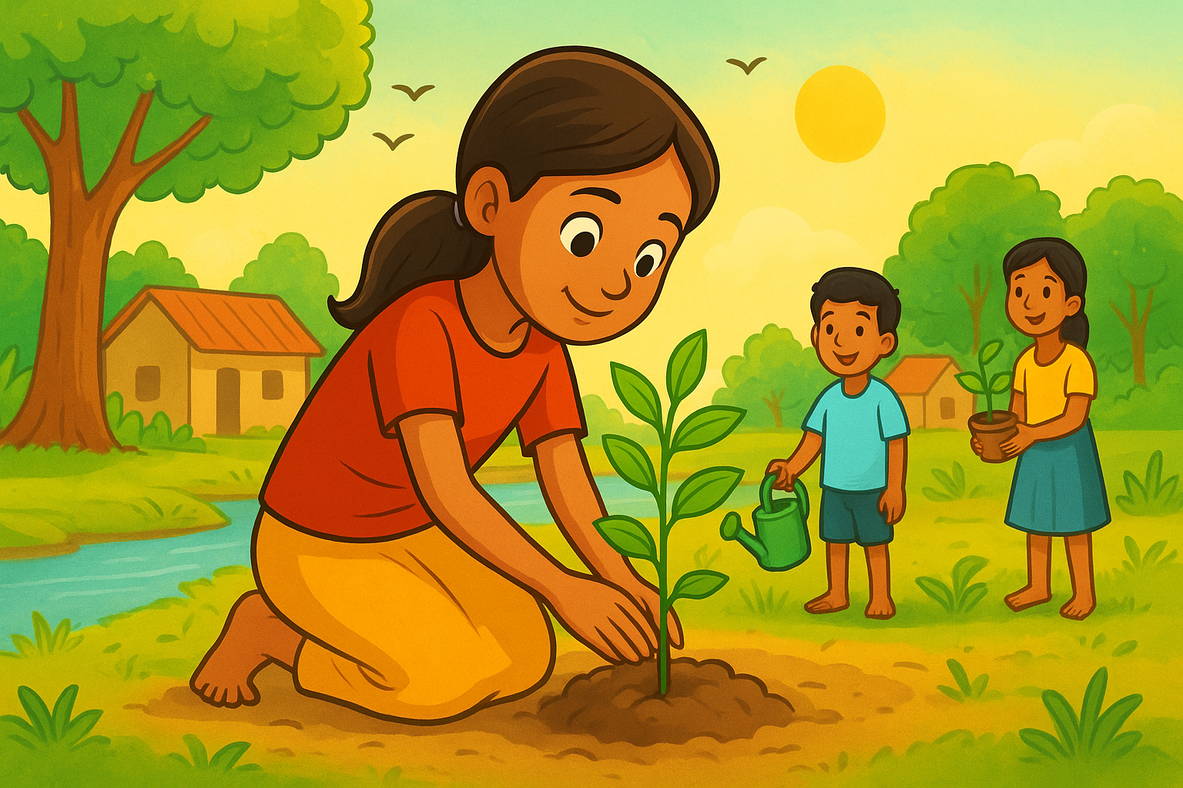
That same week, Rupa planted her first neem sapling near her school. She watered it daily from her own bottle, even when her friends laughed or forgot. Slowly, the small sapling took root. Then she planted another — a banyan, then a guava.
Within two years, several children in her school joined her. Together they created a “mini-forest” around their classrooms. Their trees began to provide shade and stopped the soil from eroding during heavy rains. Birds and butterflies returned.
The local panchayat later joined in, giving saplings to every household to grow in their backyards.
💧 The Change That Followed
Over the next five years, Rupa’s village looked completely different. The green cover grew thicker, and groundwater levels improved. Women reported that wells were no longer running dry in summer. Farmers started growing vegetables again instead of leaving land empty.
What began as one girl’s idea had now turned into a community mission.
Local newspapers wrote about her efforts, calling her “The Girl Who Planted Hope.” Environmental organizations in Assam began supporting similar student-led plantation drives, showing how children could lead change through action, not just words.
🌎 Why Rupa’s Story Matters
Rupa’s initiative is not only about trees — it’s about vision. She showed that real change doesn’t always come from large governments or global campaigns. Sometimes, it begins with one person’s care for their surroundings.
Her story connects deeply with the United Nations Sustainable Development Goals (SDGs) — especially those about climate action, life on land, and sustainable communities.
When children like Rupa take small steps, they remind everyone — even adults — that protecting the planet is not someone else’s job. It’s ours.
🌻 What We Can Learn
- Every act counts. A single tree can help the soil hold water, shelter birds, and clean the air.
- Inspiration grows. When one person begins, others follow — and soon, it becomes a movement.
- Nature gives back. What we give to the earth always returns — in cool shade, clean water, and pure air.
💚 The Message of Hope
Today, Rupa continues her education and still plants trees wherever she goes. Her once-barren village now has over 1,200 trees, planted by students and villagers together.
Her simple act reminds us all — whether child or grown-up — that you don’t need to be rich or powerful to make a difference.
You just need hope, patience, and one seed. 🌱
Did You Know?
- A single tree can absorb up to 21 kilograms of carbon dioxide every year.
- Trees can lower the temperature around them by almost 2°C to 8°C during summer.
- India aims to increase its green cover to 33% of total land area by 2030 — and young people like Rupa are helping make that goal real.