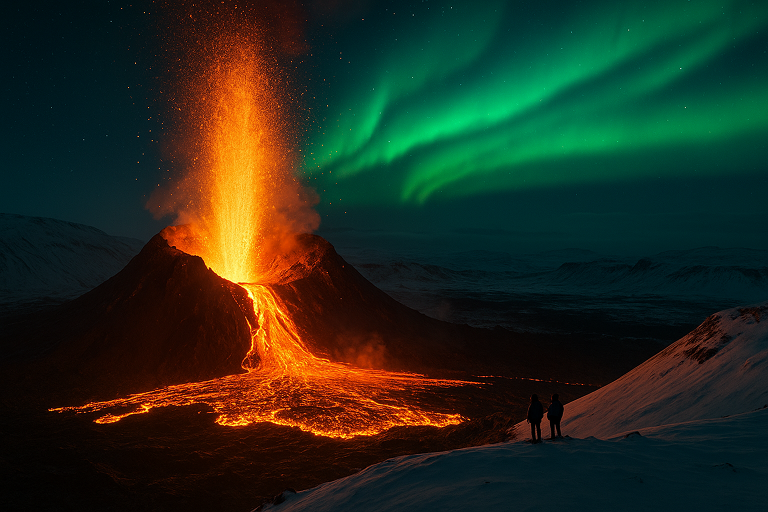
When Fire Meets Ice — Iceland’s Living Lesson from Nature
It’s hard to imagine a mountain waking up.
But that’s exactly what happened this October 2025 in Iceland, when the Reykjanes Peninsula volcano erupted again — its third eruption in just four years, after sleeping for nearly eight centuries.
For scientists and local families, it was both a breathtaking sight and a reminder of how alive our planet really is.
🌋 A COUNTRY BUILT ON FIRE
Iceland sits right on the Mid-Atlantic Ridge, where two giant tectonic plates — the North American and Eurasian — slowly pull apart.
When these plates move, molten rock called magma rises to the surface, creating earthquakes and volcanoes.
The Reykjanes area had been quiet since the 13th century — until 2021, when it suddenly came to life again.
In October 2025, glowing lava fountains shot meters into the sky near the fishing town of Grindavík, lighting up the northern night.
💬 “It’s like watching the Earth breathe fire,” said Dr. Árni Magnússon, a volcanologist at the University of Iceland.
🖼️ Illustration idea: A fiery volcano under the northern lights, with children watching from a safe viewing hill.
🏘️ PEOPLE AND PREPARATION
This time, the eruption came with a warning. Scientists had been tracking tremors for weeks, and emergency teams evacuated residents before the lava flow began.
Nobody was hurt, but roads cracked and thick ash covered cars and houses.
In Iceland, though, volcanoes aren’t seen as enemies — they’re part of life.
Hot water from underground magma heats homes and powers much of the country’s geothermal energy, making Iceland one of the world’s cleanest energy users.
💬 “The ground that shakes also keeps us warm,” said Reykjavík resident Elísabet Stefánsdóttir, smiling at her geothermal heater.
🔬 WHAT SCIENTISTS LEARN
Each eruption teaches researchers more about how our planet works.
Drones flew over the lava field collecting temperature readings and gas samples.
By studying the lava’s flow speed and mineral content, scientists can predict future eruptions and improve global safety alerts.
The Reykjanes volcano’s repeated activity is reshaping Iceland’s coastline — and possibly creating new landforms.
📦 DID YOU KNOW?
- Iceland has 32 active volcanoes, but most eruptions are small and closely monitored.
- The island grows a few centimeters wider every year as the tectonic plates drift apart.
- Volcanic soil is so rich that Icelandic farmers grow tomatoes all year round — inside greenhouses heated by magma energy!
🌍 LESSON FROM THE LAVA
Nature can be fierce, but it’s also full of wisdom.
Iceland’s people have learned to live with volcanoes, not against them — turning danger into discovery.
The next time you see a photo of glowing lava, remember: that’s Earth’s way of reminding us that it’s still alive and evolving.
💬 “The planet is not just our home — it’s a living story we’re part of.”