Imagine if you could lean against a brick wall and suddenly turn red and bumpy to match it. Or what if you turned bright blue when you were sad, and neon yellow when you were excited?
In the human world, that sounds like a movie superpower. But in the animal kingdom, it’s just a normal Tuesday! Some animals are the ultimate masters of hide-and-seek, using “biological magic” to disappear in plain sight.
The Secret Science: How Do They Do It?
Most color-changing animals don’t use magic wands—they use chromatophores (pronounced: krow-mat-a-fores).
Think of chromatophores like tiny, stretchy balloons filled with ink inside the animal’s skin.
- When the animal wants to change color, its brain sends a signal to stretch or shrink those “balloons.”
- If the balloon stretches out, the color spreads and becomes bright.
- If it shrinks into a tiny dot, the color disappears!
The Heavyweight Champions of Color
While many animals can change color, these three are the absolute legends:
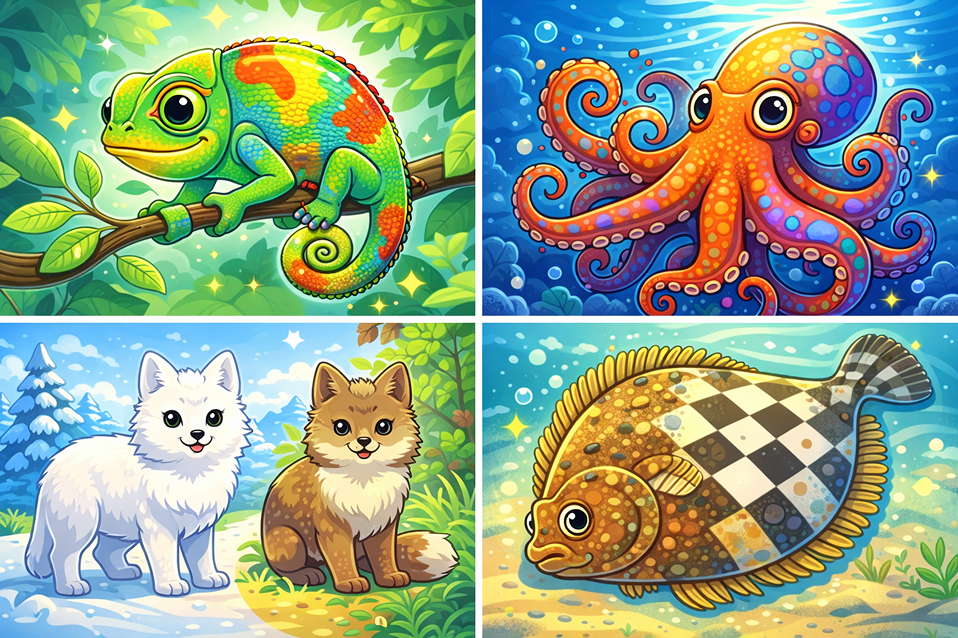
1. The “Mood Ring” Chameleon
A common myth is that chameleons change color just to hide. Actually, they are very emotional! If a chameleon is angry or wants to find a friend, it might turn bright orange or yellow. It’s like wearing your feelings on your sleeve—literally!
2. The Invisible Octopus
The Mimic Octopus and its cousin, the Cuttlefish, are the smartest color-changers. They don’t just change their color; they can change their texture too! They can make their skin bumpy like a rock or smooth like seaweed.
3. The Seasonal Wardrobe: The Arctic Fox
Some animals change color to match the calendar. In the summer, the Arctic Fox is brown to blend in with rocks and dirt. But when the snow starts to fall, it grows a brand-new coat of thick, white fur. It’s the ultimate winter coat!
Why Change Colors?
It isn’t just for looking cool. Animals use this “magic trick” for three main reasons:
- Survival (Camouflage): Hiding from a hungry predator or sneaking up on lunch.
- Temperature Control: Dark colors soak up sunlight to stay warm, while light colors stay cool.
- Talking: Using colors to say “Go away!” or “I’m the boss!” without making a sound.
Did You Know? The Cuttlefish can create “moving patterns” on its skin that look like flickering strobe lights to confuse its prey!
Pop Quiz: Are You a Color Expert?
1. What are the tiny “color balloons” in an animal’s skin called?
- A) Color-pops
- B) Chromatophores
- C) Ink-bubbles
2. Why does a chameleon usually change its color?
- A) Because it’s bored
- B) To match a polka-dot shirt
- C) To show its mood or stay warm
(Answers: 1-B, 2-C)