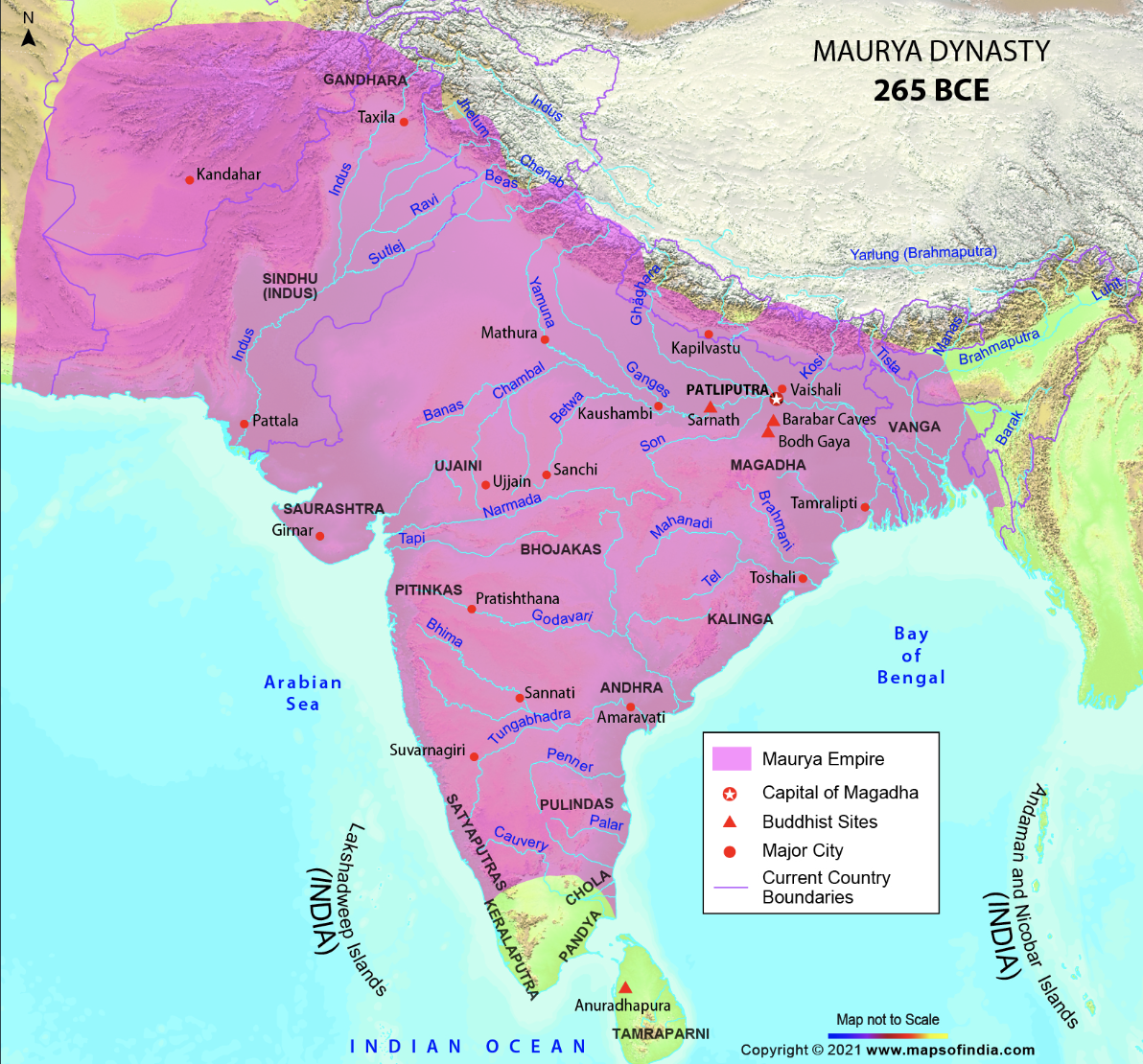
Long before modern India, a vast and powerful empire united much of the subcontinent under one rule — the Mauryan Empire. Founded in the 4th century BCE, it marked the beginning of a golden era in Indian governance, trade, and philosophy.
The Birth of the Empire
The Mauryan Empire was born when Chandragupta Maurya, a young visionary guided by his mentor Chanakya (Kautilya), overthrew the Nanda dynasty around 321 BCE. Together, they laid the foundations of one of India’s most efficient and organized administrations.
Under Chandragupta’s leadership, the empire stretched from Afghanistan to Bengal and from the Himalayas to the Deccan Plateau — making it the first truly pan-Indian empire. His capital, Pataliputra (modern-day Patna), became the political and cultural heart of ancient India.
The Golden Rule of Ashoka
The Mauryan legacy reached its height under Emperor Ashoka, Chandragupta’s grandson. After the brutal Kalinga War, Ashoka’s transformation from a conqueror to a spiritual reformer changed history.
He embraced Buddhism and spread its message of non-violence, tolerance, and dharma (righteousness) across Asia — from Sri Lanka to Central Asia.
Ashoka built stupas, hospitals, and roads, and erected the famous Ashokan pillars, inscribed with moral edicts that guided people toward compassion and good governance. The Lion Capital of Ashoka, carved from one such pillar, later became India’s National Emblem — a living link to this glorious past.
The Legacy That Lives On
The Mauryan Empire declined after Ashoka’s death, but its influence endures. It laid the foundation for centralized administration, economic policy, and moral governance that shaped Indian political thought for centuries.
Chanakya’s treatise, the Arthashastra, remains a timeless manual on statecraft, economics, and strategy — still studied by leaders and economists today.
Conclusion
The Mauryan Empire wasn’t just India’s first empire — it was a blueprint for unity, governance, and moral leadership. From Ashoka’s wheel on India’s flag to the pillars that still stand tall, its echoes remind us that India’s strength has always come from wisdom and vision.
Courtesy : Image of this map is taken from maps of India website